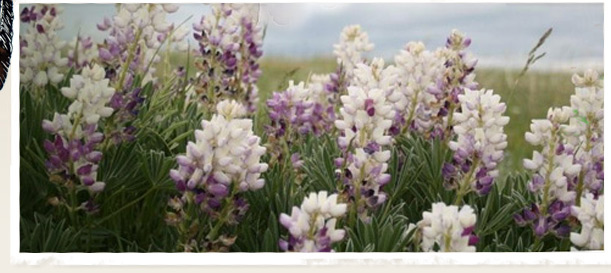
Conservation, Preservation and Restoration
"Conservation isn’t just about animals or land, it’s about people too…giving them opportunities to learn, heal, reconnect and participate."
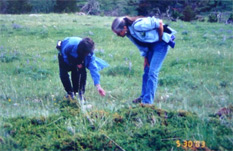
SGI works to demonstrate economically sustainable and ecologically sensitive ranching techniques while promoting the Conservation, Preservation, and Restoration of our natural landscape. SGI’s goal is to create an exemplary role model that demonstrates alternatives and multi-faceted modalities of sustaining rural and agricultural communities for the local ranching community and the region, as well as providing hands-on experience for international guests, students, interns and volunteers. What we are doing here also directly influences the preservation and renewal of the cultural heritage of the people here on the Crow Reservation, as they seek to reclaim their children and their cultural pride.
This is a living Learning Center where a diverse team of advisors and volunteers are restoring land devastated by drought and overgrazing by cattle; revitalizing degraded soils; demonstrating the economic and cultural viability of buffalo herds; practicing natural horse training and holistic care; creating organic gardens and cultivating native medicinal plants; and providing experiential learning for the local ranching community, the prairie region, as well as Internationally. SGI works collaboratively with a variety of organizations, researchers, scientists, and land management to implement and experiment through on-the-ground projects.
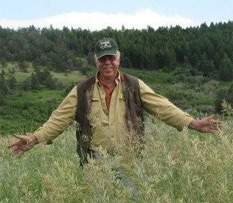
"Doc" in tall grass

Preservation:
SGI has preserved the native sagebrush prairie, which has never been plowed, nor fragmented from oil and gas drilling, large power lines or communication towers. There are no housing developments beyond the established ranch headquarters, and minimal roads used only for ranch management access. Contiguous blocks of native prairie are rare, and provide important habitat for at-risk wildlife species such as Greater Sage-Grouse, black-tailed prairie dog, black-footed ferret, swift fox, mountain Plover, sharp-tailed Grouse, bald eagle, and American bison.
» Back to Top «"As a lifetime land management consultant I visit 100's of farms and ranches and help people improve their land. This ranch is different from most conventionally managed ecosystems. The ranch is not driven by modern agriculture (to maximize production) but to take care of the land and its' diverse natural environment. Tanah is dedicated to learn, improve, and share innovative solutions to prevent land management problems...and be an educational showplace that can teach others."
Wayne Burleson, Range Management Services
Buffalo and Conservation
The sagebrush grassland requires minimal management beyond control of trespass cattle and managed moderate rotational grazing of the buffalo and horse herds.
Buffalo have always been an integral component of the native prairies. Buffalo grazing helps restore native grasses and improve soil quality. The hoof action breaks up the dead material and the crust of the ground, which allows the water to percolate into the ground to feed the grass roots. Buffalo are natural grazers that enjoy roaming the land, moving continuously over the landscape; they do not gather and “camp” in the sensitive pond and riparian areas like cattle. When they graze, buffalo don't eat below the crown of the grasses, allowing plants to regenerate, and their hooves and sizeable weight tills the soil, providing crevices for seeds to germinate.
When winter is over, buffalo begin to frolic, rolling on the ground and rubbing on trees and fences to shed their winter coats. Their winter coats act as efficient harvesters as seeds of natural grasses caught in the winter coat are re-deposited in the soil. Their sharp hooves break up the frozen ground in the spring, allowing water to percolate more easily, guaranteeing the grass roots will receive needed water from rains. In the fall, buffalo break down dead grass by rolling on the ground as well as breaking it with their hoofs. Once the grass is broken, it decomposes into the soil, and the seeds grow easily the next spring. Buffalo also use their hooves to work manure and urine back into the soil. They level out uneven land as they break down rough areas, aerating and fertilizing the ground.
In these ways, the buffalo herd is playing a key role in the restoration of the tall grass prairie, keeping the biological circle healthy. Indeed, the buffalo on the Ranch are essential to the prairie ecology. The buffalo are true native prairie animals demonstrating their supreme adaptation to their natural habitat.
Native Plants
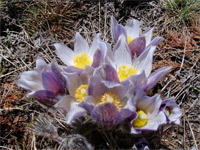 A variety of native wetland and riparian vegetation species are being planted in the spring and downstream riparian areas. These areas provide high quality habitat for many riparian-dependent wildlife species.
Cultural Restoration
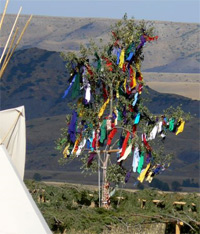 The cultural restoration that is an integral part of SGI requires certain areas be repopulated with traditional plants used for food and medicine by native people.
Restoration of buffalo, an integral component of the native ecosystem, is likewise culturally critical. Buffalo are selectively harvested for tribal food and ceremonial uses.
In addition, paint horses are the traditional horse of Plains tribes. Their beauty, endurance and adaptation to the prairie make them a highly prized cultural icon as well as a very functional horse. Keeping the genetics of this breed strong and increasing their availability contributes to the cultural restoration of the Plains tribes.
The cultural restoration that is an integral part of SGI requires certain areas be repopulated with traditional plants used for food and medicine by native people.
Restoration of buffalo, an integral component of the native ecosystem, is likewise culturally critical. Buffalo are selectively harvested for tribal food and ceremonial uses.
In addition, paint horses are the traditional horse of Plains tribes. Their beauty, endurance and adaptation to the prairie make them a highly prized cultural icon as well as a very functional horse. Keeping the genetics of this breed strong and increasing their availability contributes to the cultural restoration of the Plains tribes.